
Quality that makes a difference!
FAQ – Marking procedure
We explain which methods can be used. Our goal is to provide you with the essential basics you need to make informed decisions. If you have any further questions, please do not hesitate to contact us.
What is dot peen marking?
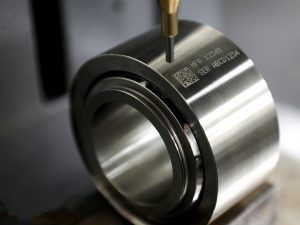
Dot peen marking is easy to explain: think of it as a small automatic chisel that rapidly taps tiny dots into a surface. A very hard needle moves up and down at high speed, making thousands of dots per minute in the material. A computer controls exactly where each dot is placed. These dots form letters, numbers, logos or even DataMatrix codes – similar to a mosaic, where many individual dots form a complete image.
The process works particularly well on metals such as steel, stainless steel or aluminium, but also on hard plastics. Since the marking is created by plastic deformation, it is permanent and extremely resistant. Oil, dirt, heat or mechanical abrasion can hardly damage it.
Dot peen marking is therefore frequently used in industry when components need to be clearly and permanently marked. Typical applications include serial numbers on vehicle parts, markings on machine components, tools, type plates or codes for traceability in modern Industry 4.0 processes.
In short, dot peen marking creates lettering or a code using many precisely placed dots – permanent, robust and ideal for industrial marking.
What is a dot peen marking machine?
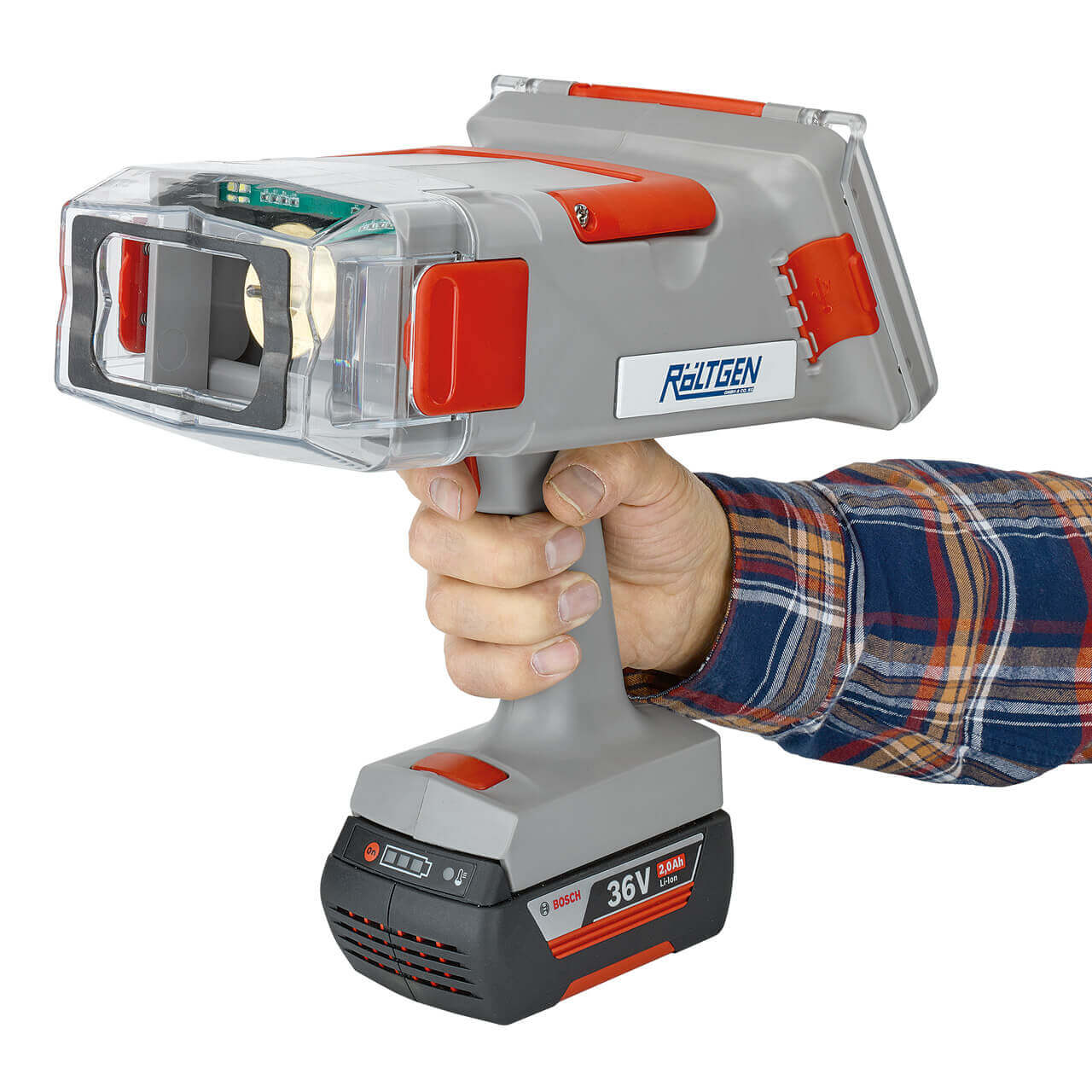
Dot peen marking devices are the devices used to perform dot peen marking. They are available in a wide variety of designs, so that the right solution can be found for almost any application. Compact floor-standing devices are often used in workshops, as they are easy to operate and flexible in use. However, if a system is to run continuously, for example in 24/7 operation, particularly robust and rigid designs are used, which are designed for durability and process reliability.
For large, heavy or difficult-to-access workpieces, portable dot peen marking machines offer maximum flexibility as they can be brought directly to the component. So-called integrator heads are available for use in automated production lines. These are permanently installed in systems and operate completely independently within the manufacturing process.
Programming is carried out either via an external or integrated control unit. Alternatively, the systems can also be controlled directly via a PLC, allowing them to be seamlessly integrated into existing production environments.
Was ist Ritzmarkieren?
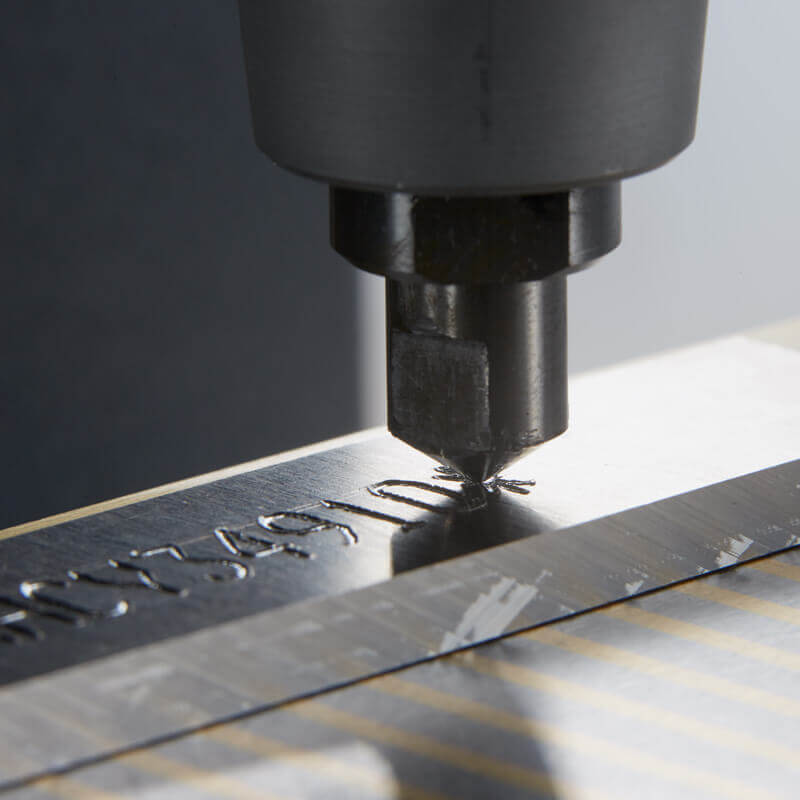
Scribe marking is easy to understand: you can imagine it as scratching a line into metal or plastic with a sharp needle or nail. The process works exactly according to this principle – only much more precisely and automatically controlled. A very hard tip is guided over the surface with constant pressure, drawing a fine, continuous line. These lines are used to create letters, numbers, logos or markings. In contrast to dot peen marking, where individual dots are set, this process produces a clean, continuous line marking.
Technically speaking, a carbide or diamond tip presses onto the workpiece while a drive system moves it precisely across the surface. This slightly displaces the material, creating a permanent engraved line.
This process is particularly suitable for metals such as steel, stainless steel and aluminium, but also works on coated surfaces and various plastics. Scribe marking is often used when a highly legible and visually appealing marking is desired. The marking is permanent and abrasion-resistant, while also being decorative and significantly quieter than dot peen marking.
Typical applications include type plates, front panels, stainless steel housings, tools or components where visible, high-quality marking is required.
In short, scribe marking involves a hard tip drawing precise lines into the material, creating a clean, permanent and legible marking.

What is a scribe marker?
Scribe markers are devices used to perform scribe marking. They are stationary and designed to produce precise and uniform line markings on workpieces. Unlike dot peen marking machines, scribe markers are not available in portable versions, as the process requires stable guidance and constant contact pressure to achieve clean and uniform lines.
Marking is carried out using a carbide or diamond tip, which is pressed onto the surface with compressed air and then guided over the workpiece in a controlled manner. This movement creates a fine, continuous engraving line. The result is a particularly legible and visually high-quality marking.
Scribe markers are often used in manufacturing environments where quiet operation, high lettering quality and permanent markings are required. Typical applications include type plates, front panels, stainless steel housings or high-quality components with visible lettering.
In addition to classic workshop and stationary systems, versions for use in automated production lines are also available. These integration solutions are permanently installed in systems and enable reproducible marking directly in the manufacturing process.
They are controlled via an integrated or external control unit; the systems can also be easily integrated into automated systems and controlled via a PLC. This makes Scribe markers ideal for reproducible marking processes in industrial series production.
What is embossing?
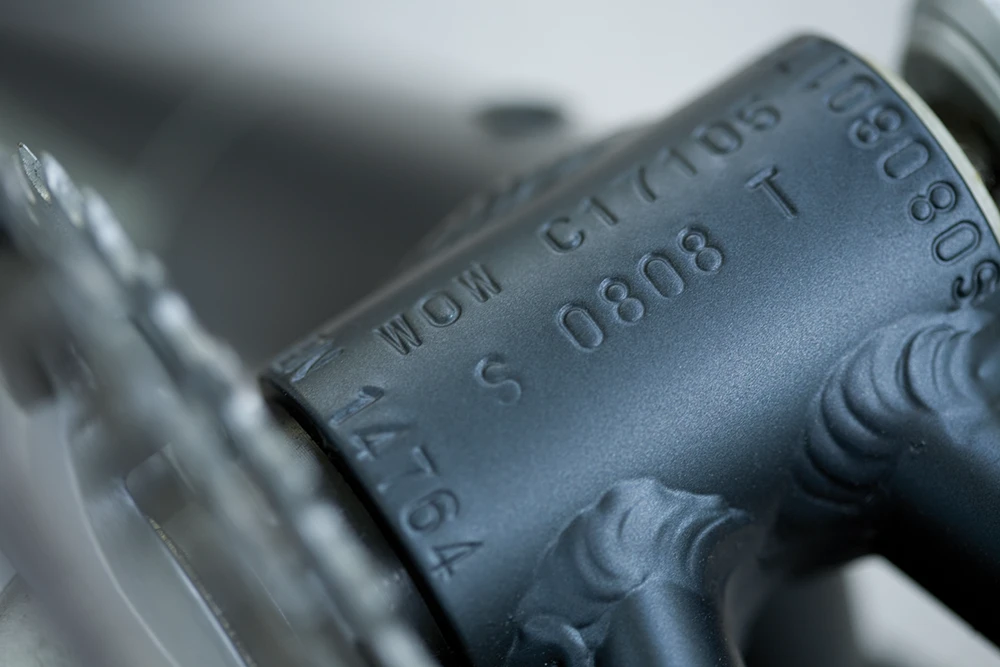
Embossing or deep embossing is easy to understand if you think of a stamp in a passport: when the stamp is pressed firmly onto the paper, it leaves a permanent indentation. The process used in industrial marking works exactly according to this principle. A shaped tool – the die or embossing stamp – is pressed into the material with great force. This plastically deforms the surface, creating letters, numbers or symbols as deep, permanently visible indentations.
Unlike printed or laser-engraved markings, the marking is not just superficial, but is a genuine deformation of the material. This means that it remains clearly visible even under extreme conditions. Heat, dirt, corrosion or mechanical abrasion have little effect on the embossing. Metals such as steel, stainless steel, aluminium and brass are particularly well suited to this process.
Deep embossed markings are used wherever maximum durability and tamper resistance are required. Typical applications include type plates, vehicle identification numbers, pressure vessel markings, energy systems, shipbuilding components and durable industrial goods.
In short, embossing involves pressing a shaped tool into the material with great force, creating a deep, permanent and extremely resistant marking.
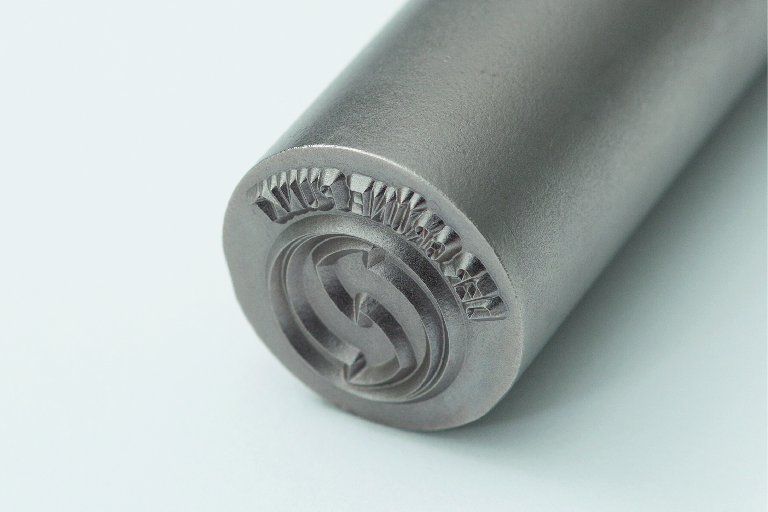
What is an embossing stamp?
Embossing stamps and impact stamps are key elements of permanent industrial marking. They are used wherever information needs to be applied to a material in a way that is not only visible but also durable and tamper-proof. Unlike print or laser marking, the marking is created by plastic deformation: the material is displaced under high force, creating a raised or recessed embossing.
An embossing die carries the mirror-inverted typeface, logos or symbols in raised form. When pressed into the workpiece, the contour is permanently transferred to the surface. Depending on the application, single stamps, type stamps or complete embossing tools are used. While single or hand stamps are often used for simple markings, multi-digit type holders or embossing tools enable the simultaneous transfer of complete information such as material markings, manufacturer data or test seals.
Embossing tools are usually made of hardened tool steel to withstand high forces and continuous stress. For special requirements – such as high quantities, abrasive materials or extreme operating conditions – special coatings or carbide designs are used to maximise service life and embossing quality.
Typical applications can be found in metalworking, plant and mechanical engineering, and safety-related areas. These include type plates, pressure vessel markings, markings in energy and transport technology, and the embossing of precious metals and bars. Wherever standards, traceability or anti-counterfeiting play a role, embossing tools offer a proven and extremely robust solution.
In short: embossing tools and embossing stamps enable deep, permanent and tamper-proof marking through targeted material deformation – reliable, durable and proven throughout the industry.
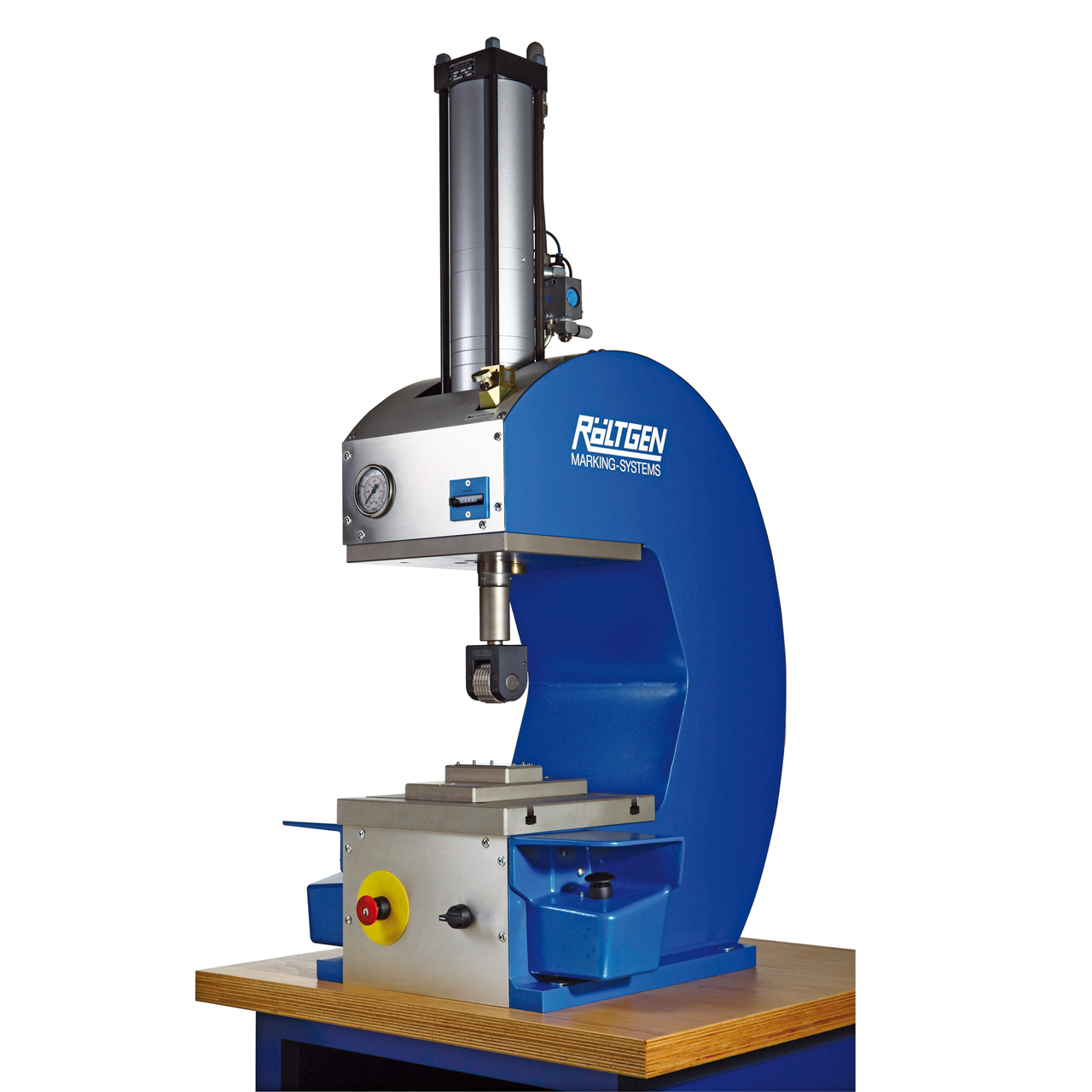
What is an embossing press?
Embossing presses can be understood as particularly powerful, precise stamping machines. They press an embossing stamp with letters, numbers or symbols into a workpiece, creating a deep and permanent marking. Depending on how the required force is generated and transmitted, there are different types of construction – including pneumatic-hydraulic embossing presses, spring-loaded presses and toggle presses.
Pneumatic-hydraulic embossing presses use compressed air to drive a hydraulic system. This amplifies the force and transfers it evenly to the embossing stamp. This results in a very high and at the same time controlled pressing force. The result is uniform, deep embossing with high repeat accuracy. These presses are often used when robust and standard-compliant markings are required, for example on type plates, safety-relevant components or metal plates.
Spring impact presses work on a different principle: a tensioned spring stores energy that is released abruptly when triggered. The embossing stamp strikes the workpiece with a short, powerful impact and creates the embossing. This process is particularly suitable for fast single embossing or smaller series where a compact design and easy handling are required.
In toggle presses, the force is mechanically amplified via a lever system. Shortly before the bottom dead centre, the toggle lever multiplies the force applied, so that a very high pressing force is generated with comparatively little effort. This design enables precise, reproducible embossing and is often used in workshops or for medium quantities.
All three press types pursue the same goal: they deform the material in a targeted manner to produce a permanent and resistant marking. The difference lies in the type of force generation, the speed and the typical application. While pneumatic-hydraulic presses offer maximum control and consistent results, spring-loaded presses score points for their speed and simplicity, and toggle lever presses offer a robust mechanical solution with high precision.
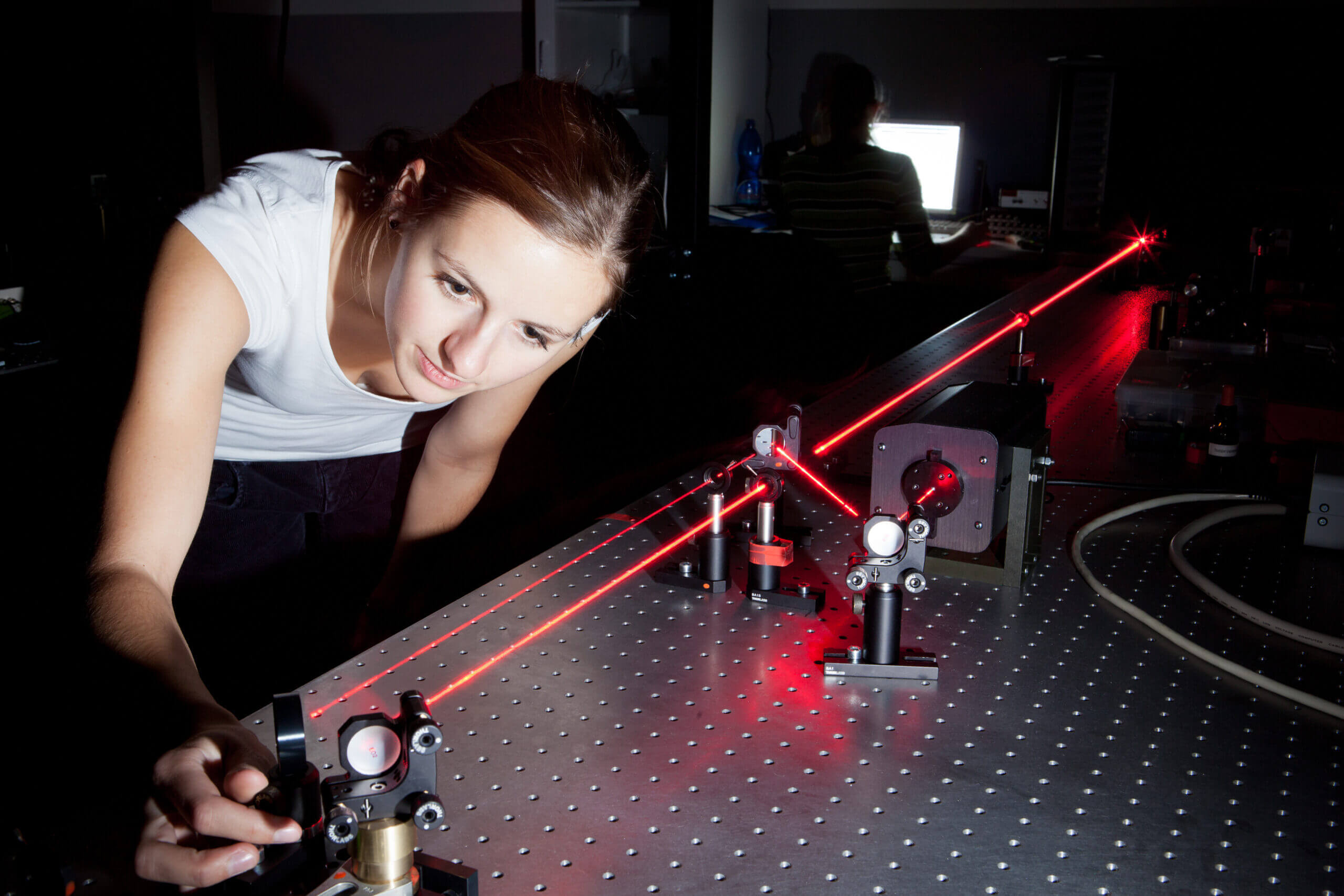
What is laser?
A laser can be understood most simply as an extremely concentrated, very precise beam of light. The word ‘laser’ is an abbreviation that stands for ‘light amplification by stimulated emission of radiation’. In simple terms, this means that light is generated inside the device, amplified and concentrated into a very focused beam.
While normal light spreads in all directions, laser light is focused on a tiny point. This creates a great deal of energy at this point. When this point of light hits a material, it can heat, discolour, melt or minimally vaporise it in a targeted manner, depending on the settings and the material.
In industrial marking, this concentrated beam of light is used like an invisible pen. The laser moves across the surface of a workpiece in a computer-controlled manner and changes it in a targeted manner to create letters, numbers, logos or codes. Since no tool comes into contact with the material, there is no wear and tear, and even sensitive components can be marked with precision.
Lasers can be used on many materials, including metals, plastics, glass, ceramics and organic materials. The markings produced are permanent, abrasion-resistant and withstand heat, chemicals and weathering. At the same time, the technology enables very fine details and machine-readable codes for modern traceability systems.
In short, a laser focuses and amplifies light into a high-energy point and uses this energy to mark materials precisely and permanently – contact-free, clean and extremely accurate.
What is laser marking?
A marking laser functions like an extremely fine, invisible pen made of light. Instead of applying ink or mechanically processing material, the device focuses a high-energy beam of light and directs it precisely onto the surface of a workpiece. There, the beam heats the material for a fraction of a second, causing a specific change in the surface. Depending on the settings, it can change colour, foam slightly or become minimally indented. This creates clearly legible inscriptions, logos or machine-readable codes.
Since the laser works without contact, there is no tool wear and even sensitive components can be reliably marked. The markings are permanent, abrasion-resistant and withstand heat, chemicals and weathering. Depending on the type of laser, metals, plastics, ceramics, glass or organic materials can be marked.
In industrial practice, laser marking is used when precision, speed and permanent legibility are required. Typical applications include serial numbers on components, type plates, brand logos or DataMatrix codes for traceability in modern production processes.
In short, laser marking uses a high-precision beam of light to permanently write information onto the surface of a material – contact-free, clean and extremely accurate.
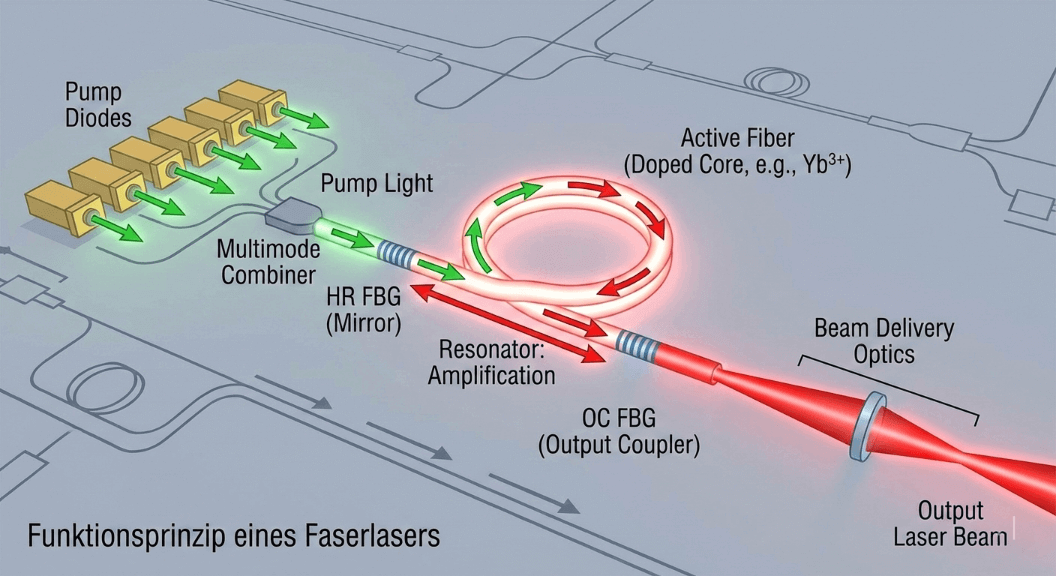
What is a fibre laser?
A fibre laser for marking basically works like an extremely precise, invisible light pen. Instead of using ink, it bundles high-energy light and directs it precisely onto the surface of a workpiece. There, the laser beam heats the material for a tiny moment so intensely that the surface changes. Depending on the settings, this creates a dark mark, a light engraving or a fine structure. In this way, letters, numbers, logos or DataMatrix codes can be produced – cleanly, permanently and without direct contact.
The name ‘fibre laser’ comes from the glass fibre inside the device, through which the laser light is guided and amplified. This makes the system particularly efficient, precise and virtually maintenance-free. Since no tool comes into contact with the material, there is hardly any wear and tear, and even sensitive components can be marked reliably.
Fibre lasers are particularly suitable for metals such as steel, stainless steel, aluminium or brass, but can also mark many technical plastics. The markings produced are abrasion-resistant, chemical-resistant and remain legible even under heat or harsh environmental conditions.
In industry, fibre lasers are used wherever speed, precision and permanent marking are required. Typical applications include serial numbers on components, type plates, logos and DataMatrix codes for traceability in modern Industry 4.0 processes.
In short, a fibre laser marks materials with a high-precision light beam, producing permanent markings – quickly, contactlessly and with extreme accuracy.
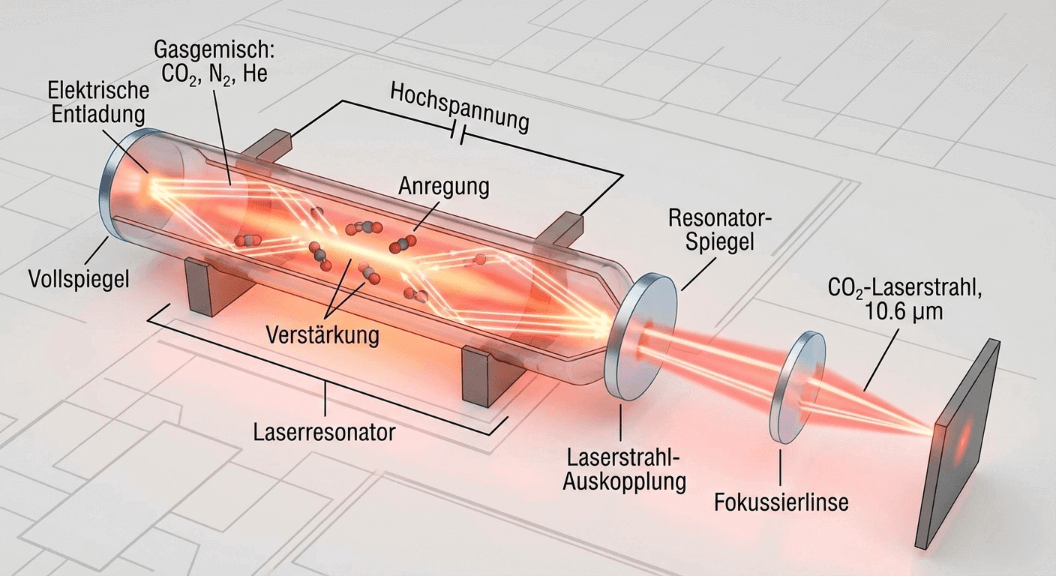
What is a CO² laser?
A CO₂ laser for marking works like a highly precise light pen that uses heat. Instead of applying ink or mechanically processing material, the device generates an invisible infrared light beam that is directed precisely onto the surface of a workpiece. When this beam hits the material, it heats it up for a tiny moment, causing the surface to change. Depending on the setting, it becomes darker, lighter, slightly foamed or finely engraved. This creates lettering, logos or codes – clean and permanent.
CO₂ lasers are particularly suitable for organic and non-metallic materials. These include plastics, wood, paper, cardboard, glass, rubber and foils. That is why they are often used in the packaging, food and consumer goods industries, for example for best-before dates, batch numbers or product information.
As the laser works without contact, there is no tool wear and even sensitive materials can be marked quickly and precisely. The marking is smudge-proof and remains legible under normal conditions of use.
In short: a CO₂ laser marks materials with an invisible heat beam, producing permanent markings – quickly, without contact and ideal for plastics and packaging.
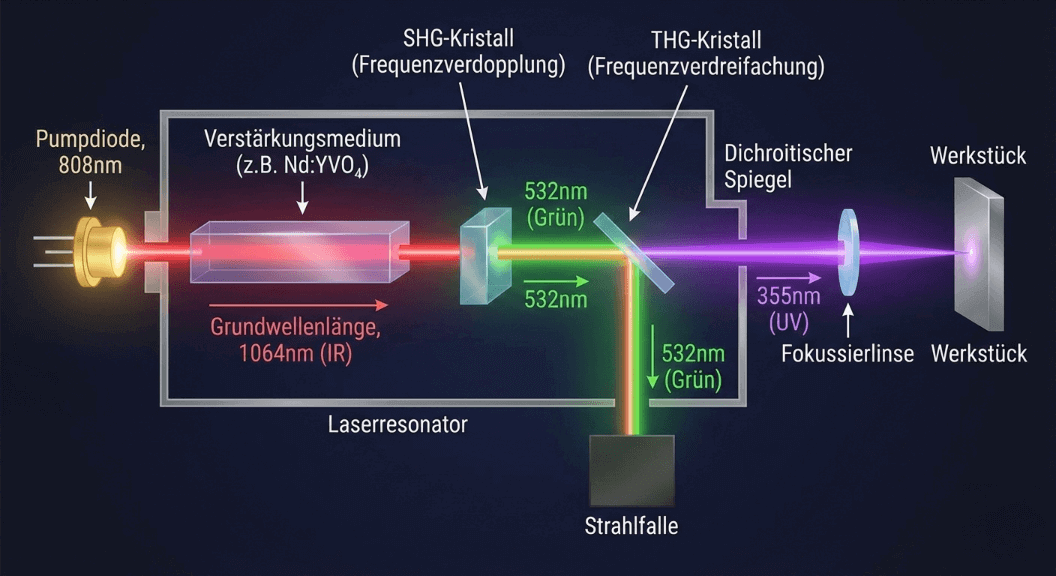
What is a UV laser?
A UV laser for marking can be thought of as a particularly fine ‘cold light pen’. Instead of heating the material to a high temperature, it works with ultraviolet light, which changes the surface at a microscopic level. The laser beam hits the workpiece for a fraction of a second, causing the surface to change chemically or structurally. This creates a clear, high-contrast marking without melting or burning the material.
It is precisely this very low heat input that is the great advantage of the UV laser. Sensitive plastics, films, glass or coated surfaces can be marked without being deformed, discoloured or damaged. This is why this technology is often used in the pharmaceutical, medical and electronics industries, where precise and material-friendly marking is required.
The markings are permanent, abrasion-resistant and highly legible, even with very small font sizes or fine codes. Even complex DataMatrix codes or micro markings can be reliably generated.
In short, a UV laser marks materials with particularly low-energy ultraviolet light and produces precise, high-contrast markings – ideal for sensitive materials and the highest quality requirements.
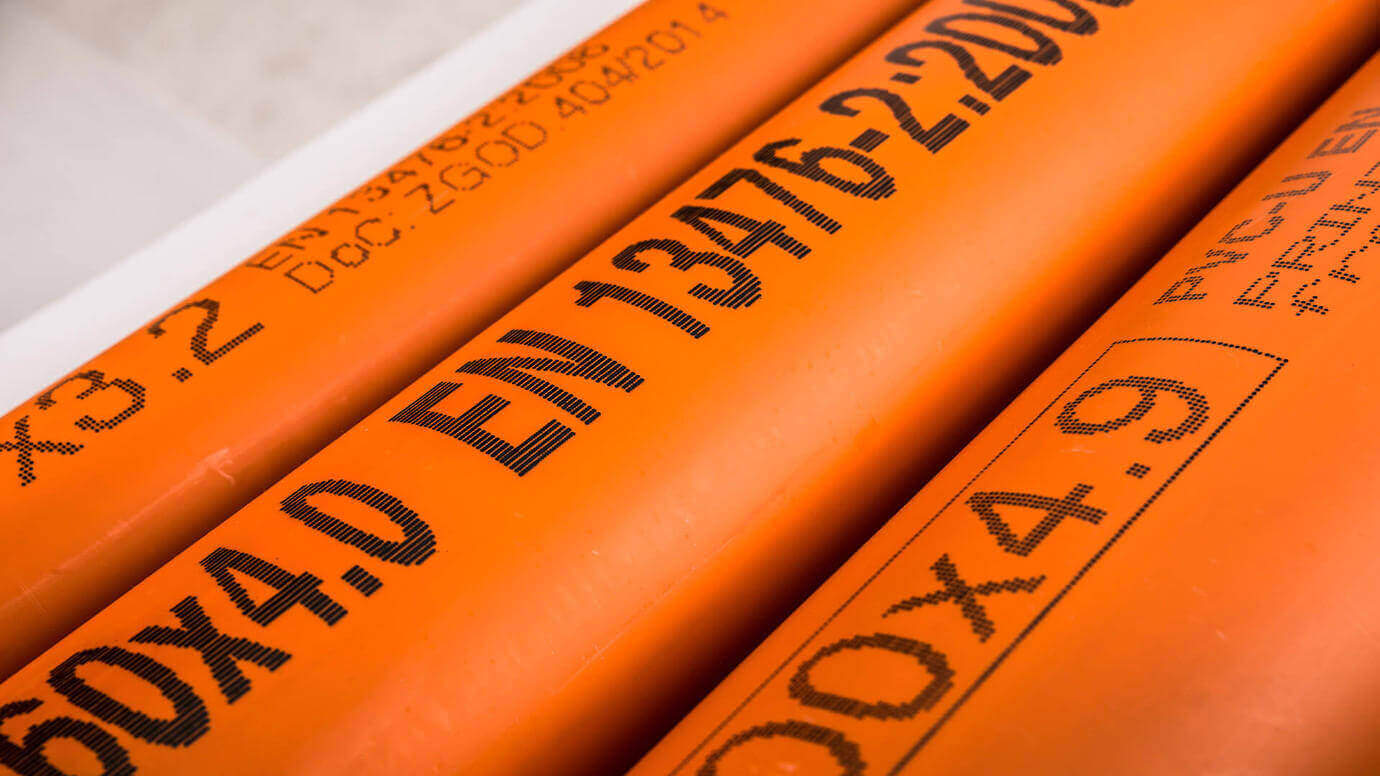
What is a ink marking?
Ink marking is used to quickly mark products – for example, with a dot, a line, a symbol or short texts. You can think of it as a stamp or felt-tip pen that applies colour to the surface. Two typical methods for this are inkjet marking and rubber stamp marking.
In inkjet ink marking, colour is sprayed on without contact. A nozzle produces tiny ink droplets that are directed precisely onto the product. This allows markings to be applied during the production process, even when the parts are moving quickly on a conveyor belt. The ink dries in seconds and adheres to many materials such as metal, plastic, glass or cardboard. Inkjet is particularly suitable when high volumes, changing content or automated processes are required.
Marking with rubber stamps is much simpler and more mechanical. A stamp with raised lettering or a symbol is dipped in ink and then pressed onto the workpiece. The motif is transferred directly onto the surface. This process is inexpensive, uncomplicated and ideal for manual workstations or smaller quantities.
Both methods pursue the same goal: clearly visible colour marking. While inkjet stands for speed, automation and flexible content, rubber stamps offer a simple and proven solution for manual applications.
In short, ink marking brings visible information to a product using colour – either contactless and automatically via inkjet or traditionally by pressing a coloured rubber stamp.
What is a CJI?
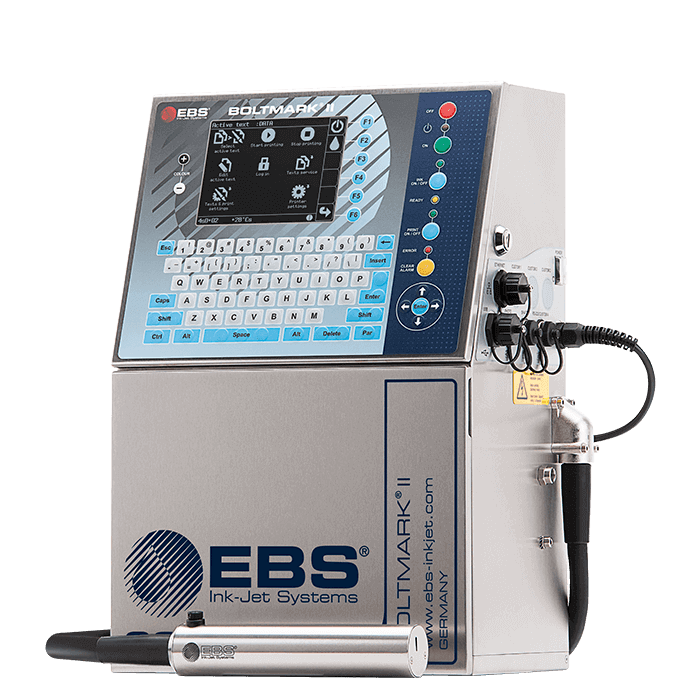
Continuous inkjet, or CIJ for short, can be thought of as an extremely fast, contactless felt-tip pen. Instead of writing with a tip, the device sprays a continuous, very fine jet of ink from a nozzle. This jet is divided into tiny droplets, which are electrically controlled and directed precisely to where the characters are to appear. Drops that are not needed fly back into the cycle and are reused. This creates text or a code without touching the product.
Since the ink jet flows continuously and the drops are produced at high speed, CIJ is particularly suitable for fast production lines. Even products moving quickly on a conveyor belt can be reliably marked with best-before dates, batch numbers or barcodes. The ink dries in a fraction of a second and adheres to many materials such as plastic, glass, metal or packaging films.
A major advantage of the process is its flexibility and speed. At the same time, it is resistant to dust, moisture and production environments with high cycle rates. This is why CIJ is frequently used in the food and beverage industry, in pharmaceutical and cosmetics production, and in the cable, electronics and packaging industries.
In short, continuous inkjet uses a fine, continuous ink jet to write information onto products – quickly, without contact and ideally suited to ongoing production processes.
We can recommend the company EBS Inkjet Systeme GmbH in this area.
What is a TIJ?
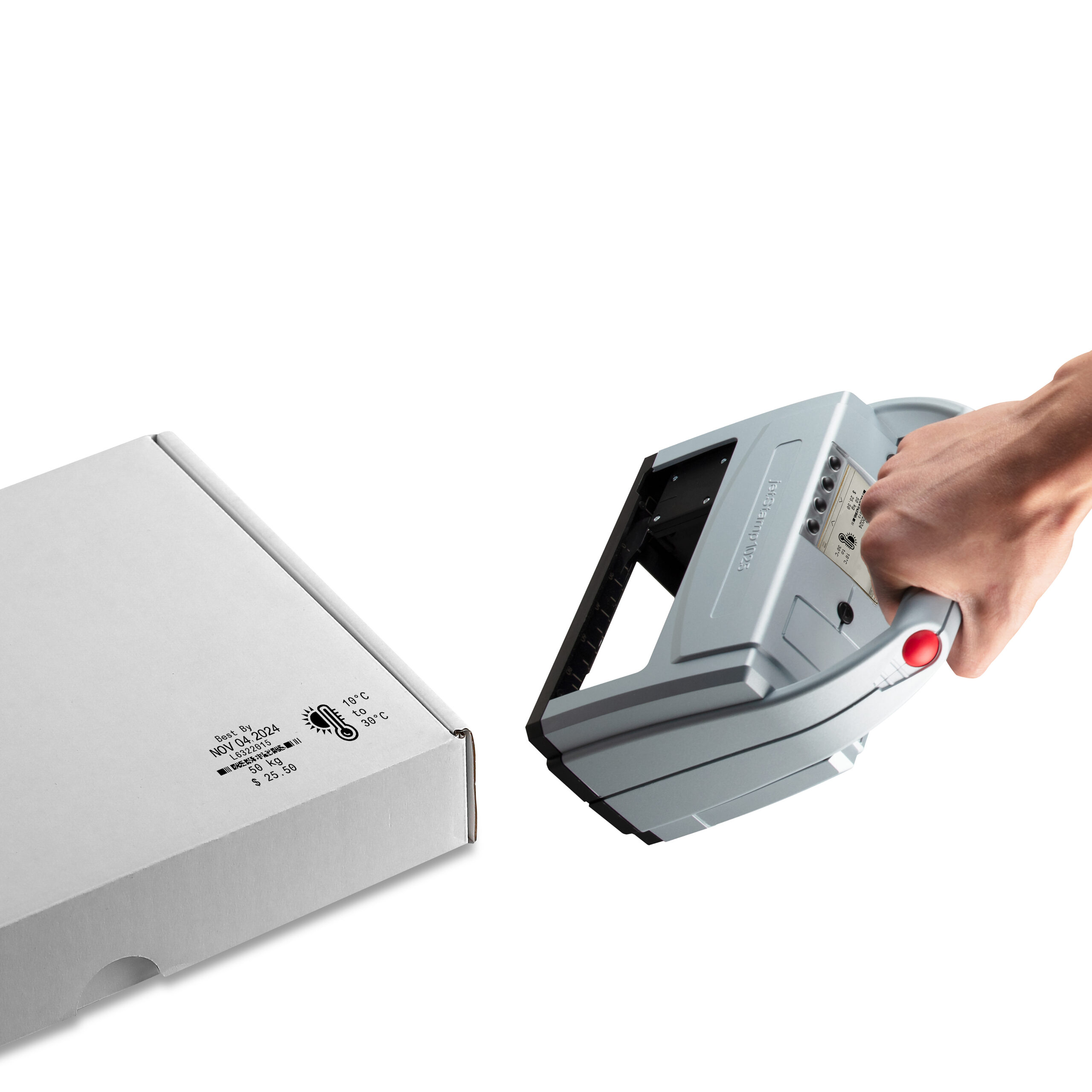
Thermal inkjet, or TIJ for short, can best be described as a highly precise inkjet printer, similar to those found in offices – except that it prints directly onto products. Inside the print cartridge are tiny heating elements. These heat the ink for a tiny moment, creating a small vapour bubble. The resulting pressure ejects a precisely measured burst of ink droplets from the nozzle onto the surface. This creates razor-sharp letters, barcodes or logos.
Since each drop is produced with precision, TIJ delivers very high print resolution and clean contours. The process is contactless and suitable for many materials such as cardboard, paper, plastic, films or coated surfaces. The ink dries quickly and ensures legible markings.
A major advantage is its low-maintenance operation: the print heads are usually integrated into the replaceable cartridges. When the cartridge is changed, a new print head is automatically available. This makes the system particularly easy to use and ideal for production environments with frequently changing print content.
The thermal inkjet device is frequently used in the packaging industry, in shipping and in consumer goods production, for example for barcodes, best-before dates, batch numbers or product information.
In short, thermal inkjet uses heat to create tiny ink droplets that are fired precisely onto a product – for clean, high-resolution markings directly in production.
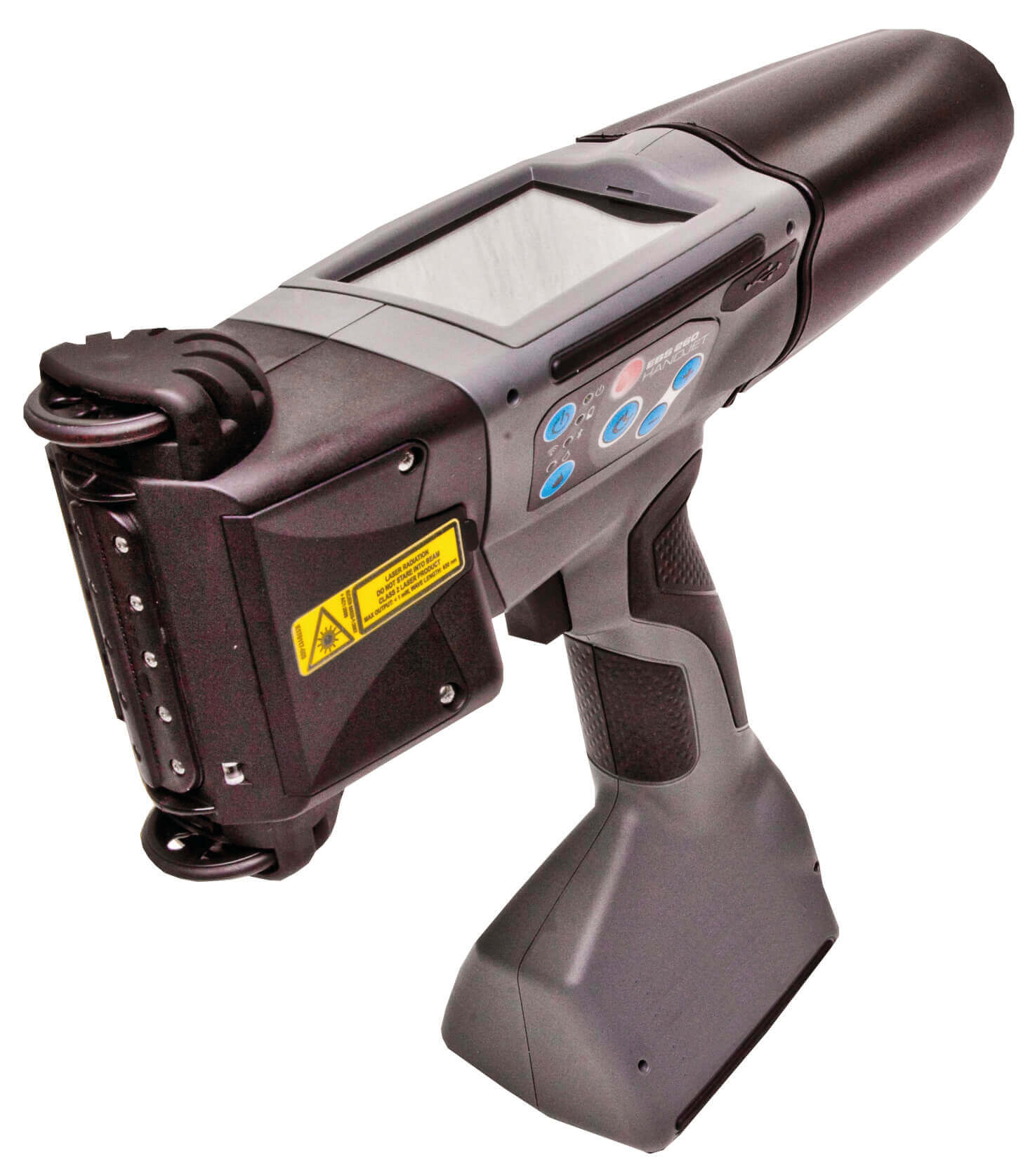
Mobile Inkjet Printer Handjet 260What is a DOD inkjet printer?
DOD inkjet, also known as large character inkjet, can be thought of as an automatic paint sprayer with very good targeting accuracy. Instead of producing a fine, continuous ink jet, the system only sprays ink droplets from the nozzle when they are really needed – hence the name ‘drop on demand’. The drops are fired precisely onto the surface and form clearly visible dots, which are used to create large letters, numbers or symbols.
This process is used when markings need to be clearly legible from a greater distance. Typical applications include labelling on cardboard boxes, shipping packaging, pallets or building materials. The font is significantly larger than with classic inkjet systems and remains clearly visible even in warehouses or logistics areas from a distance of several metres.
The DOD large font inkjet device operates without contact and is suitable for harsh industrial environments. It can print on a wide variety of surfaces such as corrugated cardboard, wood, concrete, metal or plastic. The inks used are mostly quick-drying and designed for industrial conditions.
In short, DOD or large-character inkjet printing involves spraying ink droplets onto a product in a targeted manner to create large, highly visible markings – ideal for packaging, logistics and warehouse labelling.
What is a nameplate?
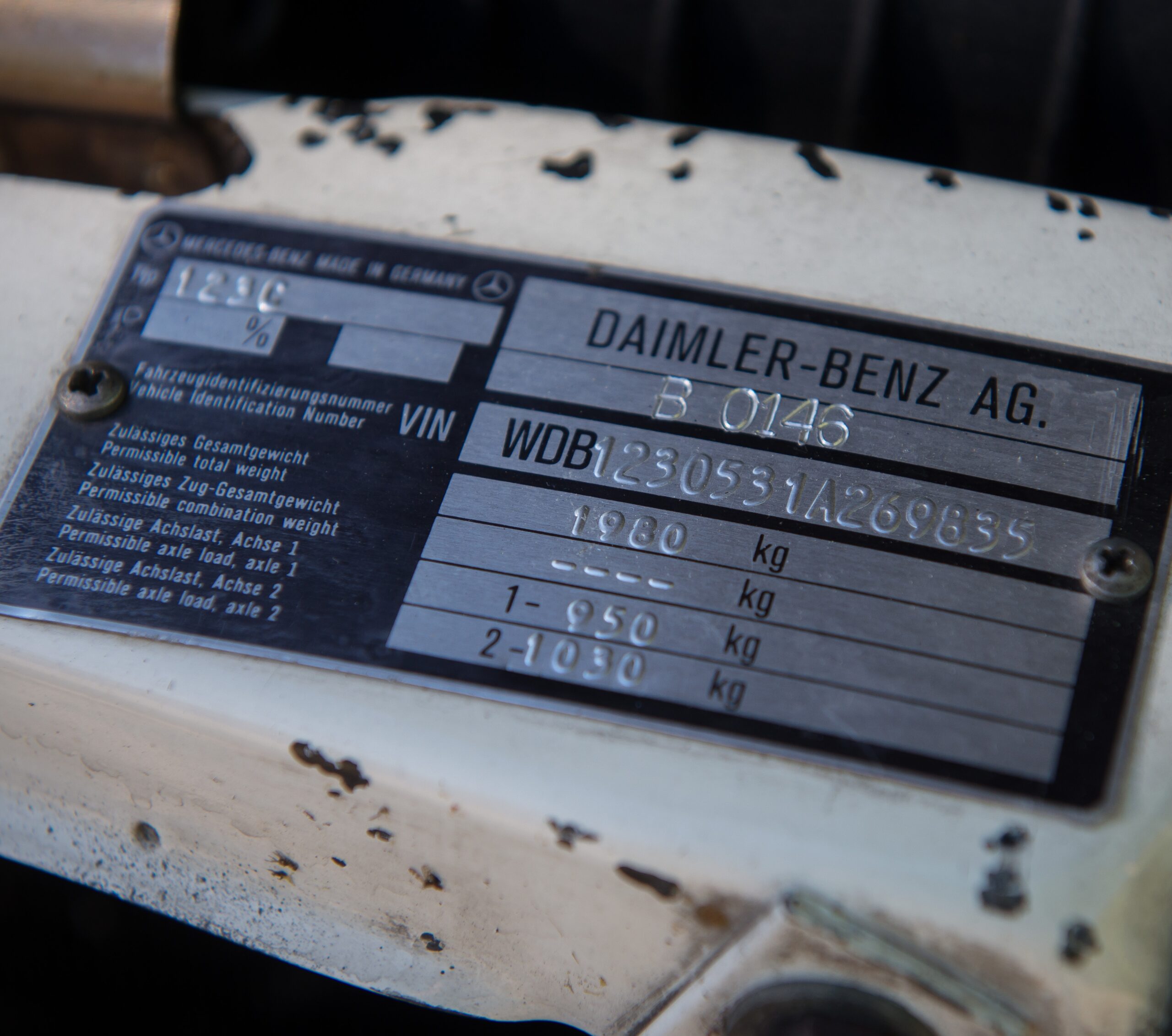
Metal or plastic nameplates can be thought of as the ‘identity card’ of a machine or component. They carry important information such as the manufacturer, serial number, technical data, test marks or approvals and ensure that a product can be clearly identified. Instead of marking the component directly, this information is affixed to a separate plate that is permanently attached to the product.
Metal nameplates are often made of aluminium, stainless steel or brass. They are particularly robust and resistant to heat, chemical influences, UV radiation and mechanical stress. The lettering can be embossed, engraved, lasered or etched and remains legible even after many years. This is why metal nameplates are mainly used in mechanical engineering, energy technology and demanding industrial environments.
Plastic nameplates are lighter and often cheaper to manufacture. They can be printed or laser-marked and offer good resistance to moisture and many chemicals. Due to their flexibility and design options, they are often used in the electrical industry, in equipment manufacturing or for indoor applications.
Nameplates not only contain text, but increasingly also barcodes or DataMatrix codes. These enable fast digital recording and support traceability as well as maintenance and service processes.
In short, nameplates provide all the important identity and technical information about a product at a glance – durable, compliant with standards and indispensable for industry, service and documentation.

What is a nameplate embossing machine?
A nameplate embossing machine is used to permanently apply information such as the manufacturer, serial number, technical data or test marks to a nameplate. It can be thought of as a special ‘labelling station’ that ensures that each nameplate is clearly legible and permanently marked. Depending on the requirements, different technologies are used, including dot peen marking machines, nameplate embossing machines and labelling lasers.
When using a dot peen marking machine, a hard needle strikes many small dots into the surface of the metal plate. These dots form letters, numbers or DataMatrix codes. The marking is deep, abrasion-resistant and remains clearly legible even after many years. This process is particularly suitable for industrial nameplates made of aluminium or stainless steel, where robustness and traceability are crucial.
Nameplate embossing devices work according to the classic embossing principle. An embossing stamp presses characters into the sign material with great force, creating a clearly perceptible indentation. This type of marking is extremely resistant to weathering, chemicals and mechanical stress. It is often used when standards or safety regulations require particularly durable marking.
A laser marking system applies the information to the nameplate without contact. A precise beam of light specifically alters the surface and creates high-contrast lettering or codes. The marking is clean, permanent and allows for very fine details, logos or machine-readable codes. Laser marking is the preferred method when a high-quality appearance, high flexibility or automated series production is required.
All three processes pursue the same goal: clear, permanent and standard-compliant marking of nameplates. While dot peen marking impresses with its robustness and coding capability, classic embossing offers maximum durability, and the laser enables precise, contactless marking with a high level of detail.

What is electrochemical etching?
Electrochemical etching for marking can be understood as controlled ‘etching’ of the surface. Instead of scratching with a tool or working with light, the material is specifically altered using electricity and a special electrolyte fluid. A template with the desired text or logo is placed on the workpiece. An electrolyte is then applied and an electrode is attached. When electricity flows, the surface reacts precisely at the exposed areas of the template. The material is minimally abraded or darkened in these areas, creating the marking.
This process takes only a few seconds and produces a clean, high-contrast marking without mechanical stress on the workpiece. Depending on the settings, the marking can appear as dark lettering or as a slight indentation in the material. As hardly any heat is generated, the material structure is preserved.
Electrochemical etching is particularly suitable for conductive metals such as stainless steel, steel, aluminium or brass. It is often used for nameplates, medical instruments, tools or components that require precise and corrosion-resistant marking.
A major advantage is the high level of detail. Even fine logos, small font sizes or complex codes can be reproduced cleanly. At the same time, the surface remains smooth and hygienic, which makes the process particularly interesting for food and medical technology.
In short: electrochemical etching uses electricity and electrolyte to specifically alter the material on the surface, creating a permanent and precise marking – clean, gentle on the material and ideal for metal surfaces.
For this process, we can recommend Ätztechnik Herbert Caspers GmbH & Co. KG in Solingen.

What is screen printing / pad printing?
Screen printing and pad printing are processes used to transfer ink cleanly and precisely onto products. They can be thought of as highly controlled stamping techniques: instead of printing by hand, a technical system ensures that logos, lettering or symmetrical patterns appear evenly and with repeatable accuracy on surfaces.
In screen printing, ink is pressed onto the workpiece through a fine-mesh fabric – the ‘screen’. Certain areas of the screen are covered so that the ink only passes through where the motif is to be visible later. The result is an opaque, even layer of ink with high durability. Screen printing is particularly suitable for flat or slightly curved surfaces and is often used for front panels, housing lettering, signs or decorative elements.
Pad printing works differently: here, an elastic silicone pad picks up the ink from an engraved printing plate and transfers it to the workpiece. As the soft pad can adapt to different shapes, even uneven, curved or textured surfaces can be printed with precision. This process is often used for small components, control elements, promotional items or complex shaped products.
Both processes deliver high-contrast, well-adhering markings. While screen printing is ideal for larger areas and high ink layer thicknesses, pad printing shows its strengths with detailed motifs and difficult geometries.
In short, screen printing and pad printing transfer ink precisely onto products – either through a stencil screen for flat surfaces or with the help of a flexible pad for uneven shapes.