
Quality that makes a difference!
FAQ – Technical questions
Do you have technical questions about embossed printing, engraving, etc.? Then you’ve come to the right place. You are also welcome to receive personal advice on site. Just get in touch with us.
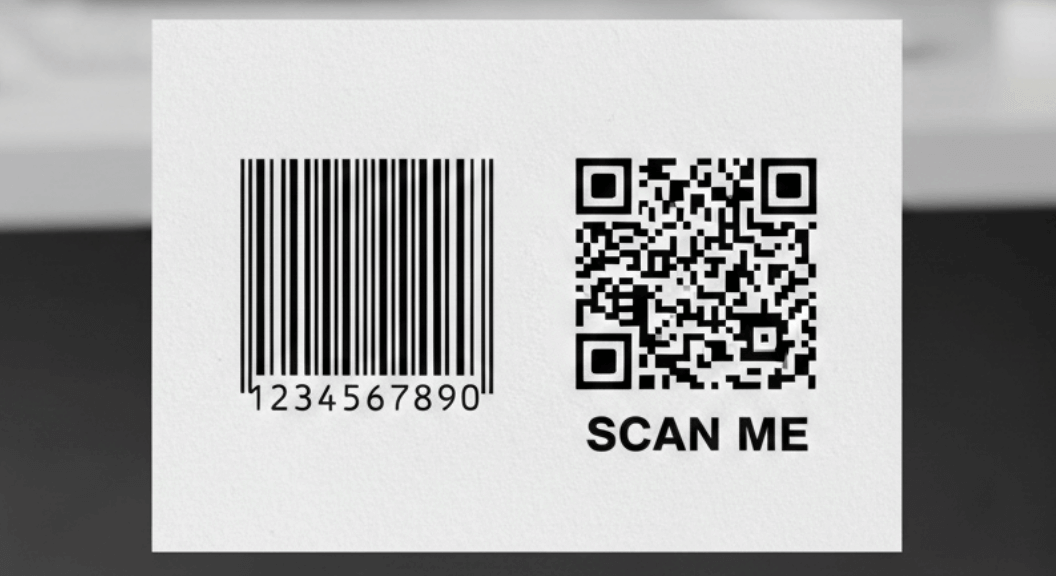
What are 1D and 2D codes?
1D and 2D codes are machine-readable labels that allow information to be quickly captured and digitally processed. They are encountered daily in everyday life, for example on product packaging, shipping labels or admission tickets. The main difference lies in how the information is stored.
1D code:
A 1D code is the classic barcode familiar from supermarkets. It consists of black lines and white spaces of varying widths, allowing numbers or short pieces of information to be encoded. A scanner reads these lines from left to right so that data can be captured quickly. 1D codes are simple in design and inexpensive, making them well suited for item numbers or short identification codes. However, their storage capacity is limited.
2D code:
A 2D code stores information not only in one direction, but across an entire area. Instead of lines, it uses dots or small squares arranged in a pattern, allowing significantly more data to be stored. Well-known examples are QR codes and data matrix codes. This structure allows serial numbers, production data or internet addresses to be encoded, and the codes remain readable even if part of them is damaged.
While 1D codes are often used for simple identification and logistics processes, 2D codes are used wherever extensive information and traceability are required. They support digital processes because data can be captured and processed directly.
In short, 1D codes store information in lines and are suitable for simple labelling, while 2D codes store data in a two-dimensional format and provide significantly more information in a small space.
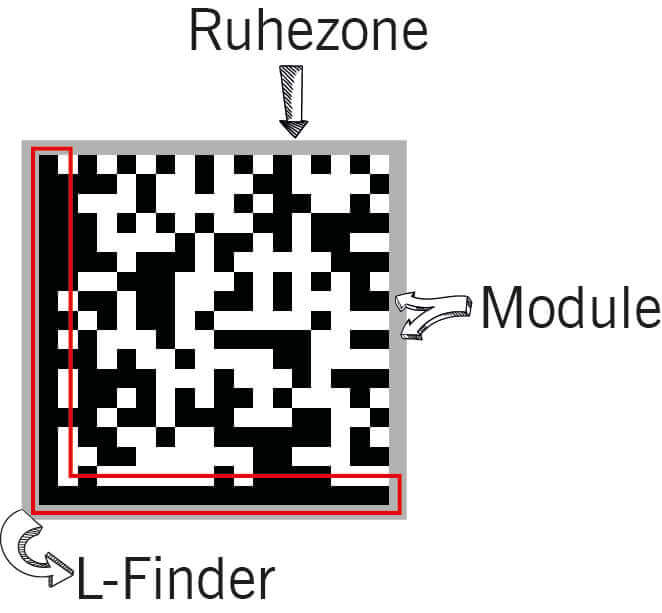
What is a Data Matrix Code (DMC)?
A data matrix code is a compact, square variant of a barcode, as it can store a large amount of information in a very small space. It can be thought of as a small pixel image: it consists of black and white dots arranged in a square so that a scanner or camera can capture the pattern. The captured data is then translated so that serial numbers, production information or web links are directly available.
Typical for the data matrix code are two continuous lines at the edges in an L-shape, as they help the reader to align quickly. This allows the code to be read reliably, even if it is at an angle or very small. The remaining dots in the centre contain the actual information, while the edge structure facilitates orientation. Despite its small size, the code can store many characters.
A major advantage is its reliability, as the code can often still be read even if part of it is damaged or dirty. It can also be marked directly onto components, for example by laser, needle embossing or inkjet, enabling permanent marking. This makes it ideal for traceability in industrial, medical technology or automotive applications, as components can be clearly identified.
In short, a data matrix code is a small square of dots that stores a lot of information and can be read quickly, while remaining robust, space-saving and ideal for modern traceability systems.
Data-Matrix-Code on Aluminium cast

How much embossing pressure do I need?
The embossing pressure can be calculated so that you can quickly determine the appropriate design. Below you will find a formula for calculating the required pressure, because the decisive factors are how many characters are to be embossed, in what font size and in what material. Therefore, the required pressure depends directly on the scope, size and material.
To perform the calculation, you need the number of embossing points and the font height or the corresponding factor (see below) so that the character height is taken into account correctly. You also need the strength per mm² of the material to be embossed, as this has a significant influence on the required pressure.
The formula includes a certain safety margin, as the presses should never operate at their upper limit. This causes them to wear out more quickly.
Embossing force calculation:
In order to select the right press or punch, it is important to calculate the required embossing force. This can be done using the following formula:
D = F x Z x ST
D = embossing force in N
F = factor (see table)
Z = tensile strength in N/mm² of the material to be embossed
ST = number of digits
| Font height in millimetres | factor to be used |
| 1 | 3,4 |
| 1,5 | 5 |
| 2 | 7 |
| 3 | 10 |
| 4 | 14 |
| 5 | 17 |
| 6 | 20 |
| 7 | 23 |
| 8 | 27 |
| 10 | 32 |
| 12 | 40 |
Example:
Embossing of 6 digits in 5 mm font height in S 355 J0 (1.0553)
D = 17 x 500 x 6 = 51000 N = 51 kN
The press should therefore have a force of at least 51 kN in order to achieve this embossing in good quality.
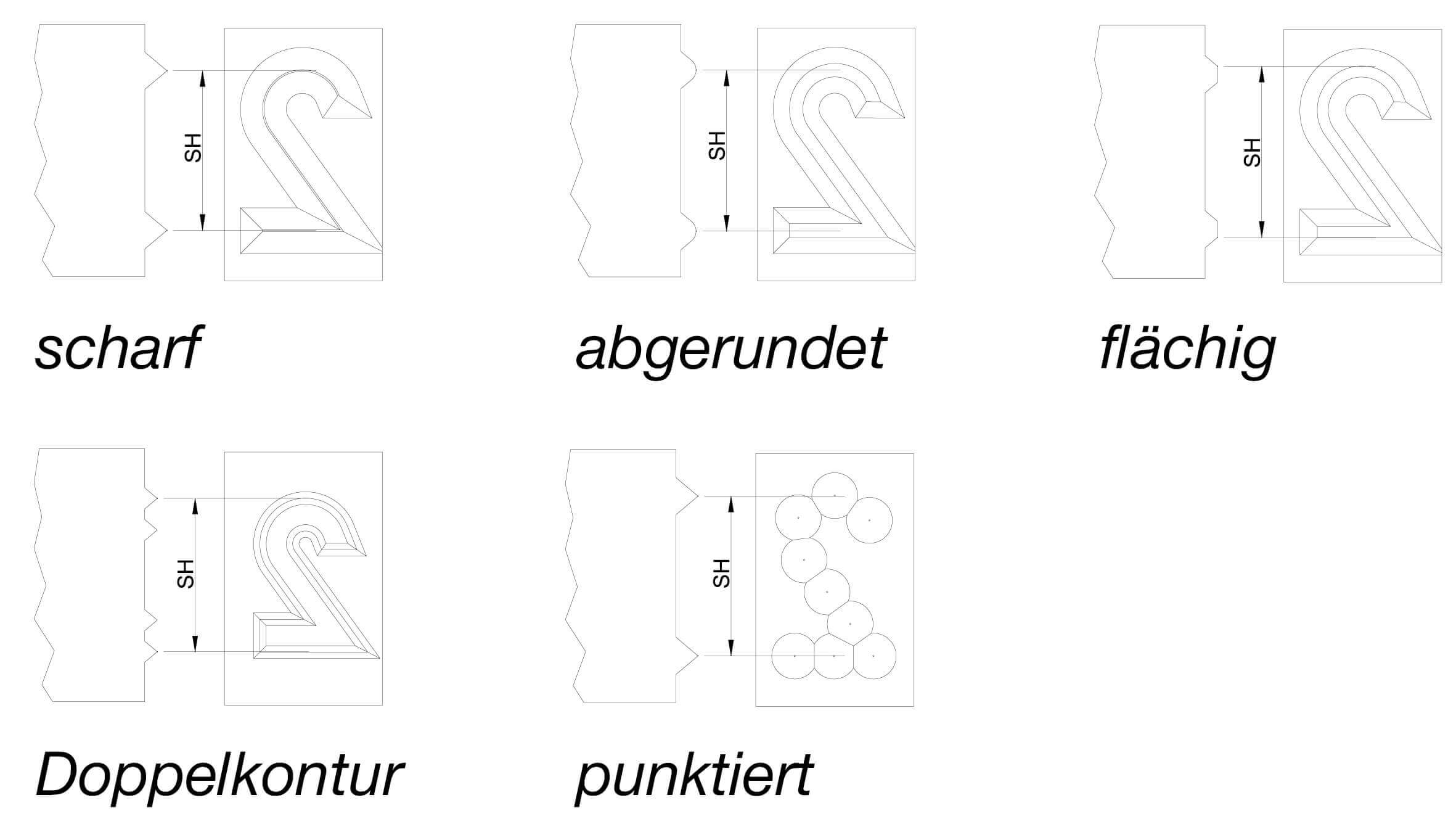
What types of engraving are there?
In principle, any font can be engraved, but the DIN 1451 font was developed for better legibility. It is used by around 90% of our customers because it is clearly recognisable and complies with standards.
In most cases, the engraving is sharp, i.e. the single-line engraving tapers to a point. This requires the least amount of embossing pressure, making this design particularly economical to use. However, it is also possible to engrave two lines; this is referred to as a double contour. If the notch effect is to be counteracted, the engraving can be rounded or dotted so that the component is not unnecessarily weakened.
The type of engraving determines the impression image and embossing force, as a sharp engraving requires less force than a flat design. If a low-stress design is required, a dotted engraving is used because this reduces tension in the material.
If you are unsure which design is suitable for your application, please contact us so that we can find the right solution together.
The type height (SH) is always measured at the highest outer point of the engraving. The easiest way to do this is to first press the stamp onto an ink pad and then roll it onto a sheet of paper lying on a hard surface. The exact type height can then be determined with a caliper, ensuring a precise result.
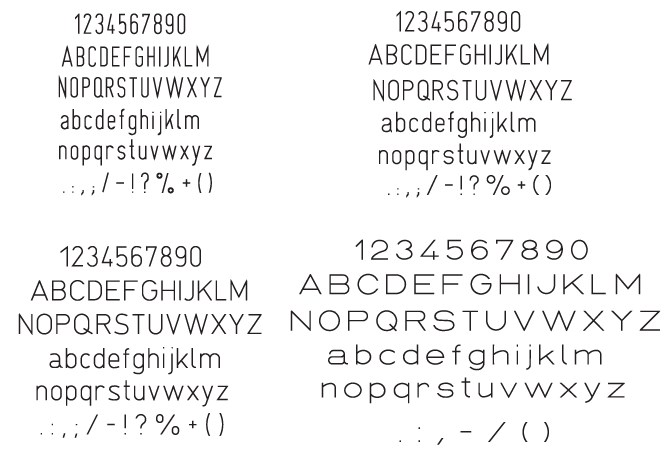
Which font can I use?
In principle, any font can be engraved, but the DIN 1451 font was developed for better legibility. It is used by around 90% of our customers because it is clearly recognisable, compliant with standards and versatile.
DIN 1451 versions:
Top left: DIN 1451-2 narrow
Top right: DIN 1451-3 narrow-medium
Bottom left: DIN 1451-4 medium
Bottom right: DIN 1451-5 wide
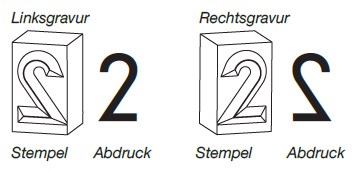
What is the difference between left-hand and right-hand engraving?
The engraving orientation determines whether the imprint is readable in the correct orientation or reversed, as the reading direction varies depending on the embossing process. This is particularly important when the medium is embossed from the reverse side but the marking is to be read from the front, as is the case with blister packaging, for example.
The orientation must also be taken into account for engravings in casting moulds, as the marking is applied to the mould in mirror image so that it appears correctly legible on the cast part later on. Correct orientation prevents mis-embossing, so that components can be clearly marked and used without reworking.
Left-hand engraving = impression legible
Right-hand engraving = impression not legible